





Bidirectional Inverter Buyer's Guide: Choose the Right Model
- Why bidirectional inverters matter
- What a bidirectional inverter does
- Market drivers and common use cases
- Trend and standards context
- Key technical specs and how to compare models
- Power rating, continuous vs. peak/surge
- Round-trip efficiency and losses
- Waveform quality and load compatibility
- Topology, control features and interoperability
- Topology: transformerless vs. transformer-based
- Grid-forming vs. grid-following
- Communications, control and standards
- Sizing, selection workflow and cost considerations
- Sizing method — a practical example
- Cost drivers and lifecycle cost
- Comparison table: bidirectional vs. common alternatives
- Reliability, certifications and supplier selection
- What certifications and testing to require
- Warranty, field support and firmware updates
- Why supplier engineering capability matters: manufacturer checklist
- Manufacturer spotlight: Guangzhou Congsin Electronic Technology Co., Ltd.
- Installation, commissioning and maintenance best practices
- Site assessment and installation checklist
- Maintenance and firmware lifecycle
- Decommissioning and recycling
- Frequently asked questions (FAQ)
- 1. What is the difference between a bidirectional inverter and a hybrid inverter?
- 2. Can a bidirectional inverter work with any battery chemistry?
- 3. Do I need grid-forming capability for backup power?
- 4. What certifications should I insist on for a bidirectional inverter?
- 5. How do I calculate required inverter power for an EV-to-home (V2H) scenario?
- 6. Is there a difference between vehicle-to-grid (V2G) and vehicle-to-home (V2H)?
- Contact & next steps
Bidirectional inverters are increasingly central to decarbonization and energy resilience strategies because they convert DC battery energy to AC loads and simultaneously accept AC (or DC via rectification) to recharge storage—enabling functions like PV-coupled storage, vehicle-to-grid (V2G), backup power and load-levelling. This guide helps procurement teams, system designers and advanced homeowners choose the right bidirectional inverter model by focusing on core technical specs, application-fit, interoperability and vendor selection criteria backed by international standards and best practices.
Why bidirectional inverters matter
What a bidirectional inverter does
A bidirectional inverter performs two complementary functions: it converts DC to AC to power loads (inverter mode) and converts AC to DC or channels AC-derived power to recharge batteries (charger/rectifier mode). This dual capability enables energy flow in both directions between battery storage and the AC grid or load, providing capabilities such as backup, peak shaving, time-shifting and V2G services. For background on inverter fundamentals see the general inverter overview on Wikipedia (Wikipedia: Inverter).
Market drivers and common use cases
Key drivers include higher renewable penetration, demand charge management, resilience needs for off-grid or weak-grid locations, and electrification of transport (V2G). Typical use cases: residential solar + storage systems, commercial microgrids, EV charging with vehicle-to-home or vehicle-to-grid, portable power stations, and industrial backup where bidirectional charging and discharge optimize asset usage.
Trend and standards context
Grid interconnection and safety are governed by standards such as IEEE 1547 for distributed resources and IEC/EN standards for power-conversion safety. Compliance with these standards is a must for grid-tied bidirectional operation and is often required by utilities—see IEEE 1547 details (IEEE 1547).
Key technical specs and how to compare models
Power rating, continuous vs. peak/surge
Match the inverter’s continuous power rating (kW) to the expected continuous load. Peak or surge rating matters for motor or compressor starts. A 3–5× surge capability for short durations is common for models designed for motors. Manufacturers’ datasheets are the authoritative source for these numbers—always verify continuous and surge power at rated ambient temperature.
Round-trip efficiency and losses
Round-trip efficiency (battery charge and discharge including inverter losses) is a key economic metric. Modern high-quality bidirectional inverters typically show inverter efficiencies in the 95–98% range in rated conditions; system-level round-trip (including battery and BMS losses) is lower. For general inverter efficiency ranges consult DOE/NREL resources on inverters and storage systems (U.S. Department of Energy).
Waveform quality and load compatibility
Pure sine wave output is required for sensitive electronics and to meet many grid interconnection requirements. Modified sine wave inverters exist for cost-sensitive, non-critical loads but are not recommended for modern appliances, inverters for grid-tie, or for V2G applications.
Topology, control features and interoperability
Topology: transformerless vs. transformer-based
Transformerless topologies give higher efficiency and lower weight but require galvanic isolation measures for safety in certain installations. Transformer-based designs provide inherent isolation and can simplify certain protection schemes but at the cost of lower efficiency and higher weight.
Grid-forming vs. grid-following
Grid-following (grid-tied) inverters synchronize to the grid and depend on it for a stable reference. Grid-forming inverters can establish voltage/frequency and are essential for islanded microgrids and resilient backup systems. If you need true off-grid or black-start capability, select a grid-forming bidirectional inverter.
Communications, control and standards
Open communication standards (Modbus, CAN, SunSpec, OCPP for EV chargers) enable integration with EMS (energy management systems), BMS (battery management systems) and building automation. Verify that the model supports protocols you need. Standards bodies such as SunSpec Alliance and IEEE publish integration guidelines—information on interoperability best practices is available from industry resources and IEEE publications.
Sizing, selection workflow and cost considerations
Sizing method — a practical example
Step 1: Define requirements (back-up vs. daily cycling vs. V2G). Step 2: Determine peak and continuous loads. Step 3: Calculate battery capacity required (kWh) to meet autonomy goals. Step 4: Choose an inverter whose continuous power >= peak continuous demand and whose charger rating matches desired charge speed (kW). Example: A house with 3.5 kW continuous loads, 7 kW EV charger and target 8 hours autonomy at 5 kW average → battery ~40 kWh. Choose a bidirectional inverter with at least 6–8 kW continuous and charger/bi-directional rating matching EV charge/discharge needs.
Cost drivers and lifecycle cost
Major cost drivers: power rating, charger rating (kW), integrated EMS, certifications, and warranty. Consider lifecycle cost: higher-efficiency units and those that enable more frequent battery cycling at low degradation can reduce total cost of ownership by improving usable kWh throughput.
Comparison table: bidirectional vs. common alternatives
| Type | Role | Typical Efficiency | Best for | Relevant Standards |
|---|---|---|---|---|
| Bidirectional inverter | DC↔AC conversion, integrated charger/discharger | 95–98% (inverter), system round-trip varies | PV+storage, V2G, backup, peak-shaving | IEEE 1547, IEC/EN safety standards, local grid codes |
| Unidirectional inverter + separate charger | DC→AC (inverter) + AC→DC (separate charger) | Inverter 94–98%; extra conversion lowers round-trip | Flexible legacy systems, modular upgrades | IEC/EN standards per component |
| Hybrid inverter (single-direction with DC-coupled battery) | Often DC-coupled battery management; may lack full bidirectional grid capability | 94–97% | Residential PV with managed battery (no V2G) | Local grid codes, manufacturer specs |
Sources: U.S. Department of Energy inverter overview (energy.gov), inverter technology summary (Wikipedia).
Reliability, certifications and supplier selection
What certifications and testing to require
Essential certifications include safety and EMC approvals (CE/EMC/LVD in EU, ETL/UL in North America), RoHS for hazardous substances, and ISO9001 for the manufacturer’s quality system. ISO 9001 details are available at the ISO website (ISO: ISO 9001). For grid-interactive inverters, utility interconnection compliance (often based on IEEE 1547 or local amendments) is required.
Warranty, field support and firmware updates
Look for clear warranty terms (years, throughput limits), available firmware updates (for anti-islanding, protection curves and feature improvements), and accessible technical support channels. Field-swappable parts and modular designs reduce downtime in commercial deployments.
Why supplier engineering capability matters: manufacturer checklist
Ask suppliers about automated production lines, sample/testing equipment, patent portfolio and OEM/ODM experience. Verify factory QA (e.g., ISO9001), environmental compliance (RoHS, REACH), and third-party test reports. Request typical MTBF/MTTR values, and ask for reference projects in similar deployments.
Manufacturer spotlight: Guangzhou Congsin Electronic Technology Co., Ltd.
Guangzhou Congsin Electronic Technology Co., Ltd., founded in early 1998, is a professional power inverter manufacturer with over 27 years of focused experience. We design, R&D and manufacture a wide range of power solutions—with a core emphasis on DC→AC power inverters, portable power stations, and solar charge controllers. Our catalog includes 100+ models tailored for vehicles, solar systems, RVs and trucks, off-grid homes, outdoor offices, patrol and field construction work.
We operate fully automated production lines, advanced instrumentation and multifunctional testing equipment to ensure product reliability, efficiency and intelligent functionality. Environmental and safety compliance are built in: our quality system is ISO9001 certified and many products hold international approvals such as CE, EMC, LVD, ETL, FCC, RoHS and E-MARK. Several independently developed patents further demonstrate our commitment to innovation.
Congsin’s products serve global markets across Europe, the Americas, the Middle East, Africa and Southeast Asia; many models are supplied to domestic and international OEM channels. Our support includes OEM/ODM, private labeling, distribution and bespoke customization to meet partner specifications.
Our mission is to deliver reliable, efficient and affordable energy solutions that enable energy independence. Congsin’s main product lines include Solar Charge Controller, modified sine wave inverter, pure sine wave inverter and portable power stations. The company’s competitive strengths include long-term manufacturing experience, automated production capability, wide certification coverage and flexible OEM/ODM services—factors that ease qualification and reduce supply risk for large projects.
Installation, commissioning and maintenance best practices
Site assessment and installation checklist
Key items: ambient temperature and ventilation, wire sizing and AC protections (breakers, fuses), earth/grounding, surge protection, and proper battery enclosure and BMS integration. Commissioning must include protection setpoint verification, anti-islanding tests where applicable, and remote monitoring configuration.
Maintenance and firmware lifecycle
Periodic inspections of connections, firmware upgrades (via secure channels), and battery health monitoring are essential. Maintain logs for cycles and firmware versions to facilitate troubleshooting and warranty claims.
Decommissioning and recycling
Follow local regulations for electronic waste and battery recycling. Many regions require documented end-of-life handling; suppliers with take-back programs simplify compliance.
Frequently asked questions (FAQ)
1. What is the difference between a bidirectional inverter and a hybrid inverter?
A bidirectional inverter explicitly supports AC↔DC conversion in both directions with integrated charging/discharging control and often supports V2G. A hybrid inverter may combine PV inverter and battery management functions but might not provide full bidirectional grid services or V2G capability. Check the datasheet and feature list to confirm bidirectional and V2G support.
2. Can a bidirectional inverter work with any battery chemistry?
Most bidirectional inverters can work with common battery chemistries (Li-ion, lead-acid) but require correct BMS integration, voltage compatibility, and charging algorithm support. Always confirm supported battery voltage ranges and charge profiles with the manufacturer.
3. Do I need grid-forming capability for backup power?
Yes — if you require the inverter to establish voltage and frequency in an islanded condition (i.e., power critical loads without grid presence), choose a grid-forming bidirectional inverter. Grid-following units cannot operate in islanded mode without an external grid-forming source.
4. What certifications should I insist on for a bidirectional inverter?
Minimum certifications: safety (CE/LVD, UL/ETL for North America), EMC, and manufacturer quality system evidence (ISO9001). For grid interconnection, compliance with IEEE 1547 or equivalent local standards is often required. Confirm the exact utility interconnection requirements before purchase.
5. How do I calculate required inverter power for an EV-to-home (V2H) scenario?
Estimate the maximum simultaneous AC load that will be supported from the EV (e.g., home loads + EV discharge). The inverter continuous kW rating must meet or exceed that figure. For example, if expected peak home load is 4 kW and you need the EV to supply up to 6 kW for charging/discharging, choose an inverter with ≥6 kW continuous bidirectional rating and appropriate charger/discharge current limits.
6. Is there a difference between vehicle-to-grid (V2G) and vehicle-to-home (V2H)?
Yes. V2G refers to exporting energy from a vehicle battery back to the wider grid (can provide ancillary services), while V2H refers to exporting vehicle battery energy to a local home or building. Both require bidirectional power conversion but differ in control, metering, and often in regulatory/utility approval requirements.
Contact & next steps
If you need tailored model recommendations, project quotations or OEM/ODM support, contact Guangzhou Congsin Electronic Technology Co., Ltd. for product lists, datasheets and engineering consultation. Our specialists can help specify bidirectional inverter models, propose system architectures, and provide compliance documentation for project approval.
Relevant resources and standards referenced: U.S. Department of Energy inverter overview (energy.gov), inverter fundamentals (Wikipedia), IEEE 1547 interconnection standard (IEEE 1547), ISO 9001 quality management (ISO), CE marking overview (EU Commission: CE).
For technical quotations, sample testing or OEM/ODM inquiries, please reach out to Guangzhou Congsin Electronic Technology Co., Ltd. — our engineers will assess your use case and recommend the optimal bidirectional inverter model for reliability, efficiency and compliance.
2000W Inverter for Solar Systems: Compatibility and Tips
Off-Grid vs. Hybrid Solar Inverters: Which Is Best for You?
Car Inverter Pure Sine Wave Specs: Wattage, Voltage, Efficiency
Top Pure Sine Wave Inverters for RVs and Camping 2026
Modified Sine Wave Inverters
What is the difference between modified sine wave and pure sine wave?
Modified sine wave is suitable for most ordinary home appliances and electronic devices; pure sine wave is suitable for devices with extremely high power requirements (such as precision instruments). This modified sine wave is more cost-effective and meets the needs of most daily scenarios.
How many devices can it power at the same time?
Dual universal sockets + two USB ports can power multiple devices (such as two home appliances + two mobile phones) at the same time, as long as the total power does not exceed 600W.
Can the peak 720W supply power continuously?
The peak power is the instantaneous maximum power, and the continuous power supply is 360W. Ensure that the device power does not exceed the rated value when using.
What devices can it power?
Suitable for fans, lights, TVs, laptops, and small electric tools.
OEM & ODM Services
What’s the main difference between your OEM and ODM services?
OEM uses your brand on our standard products; ODM creates entirely new products based on your concept or specification.
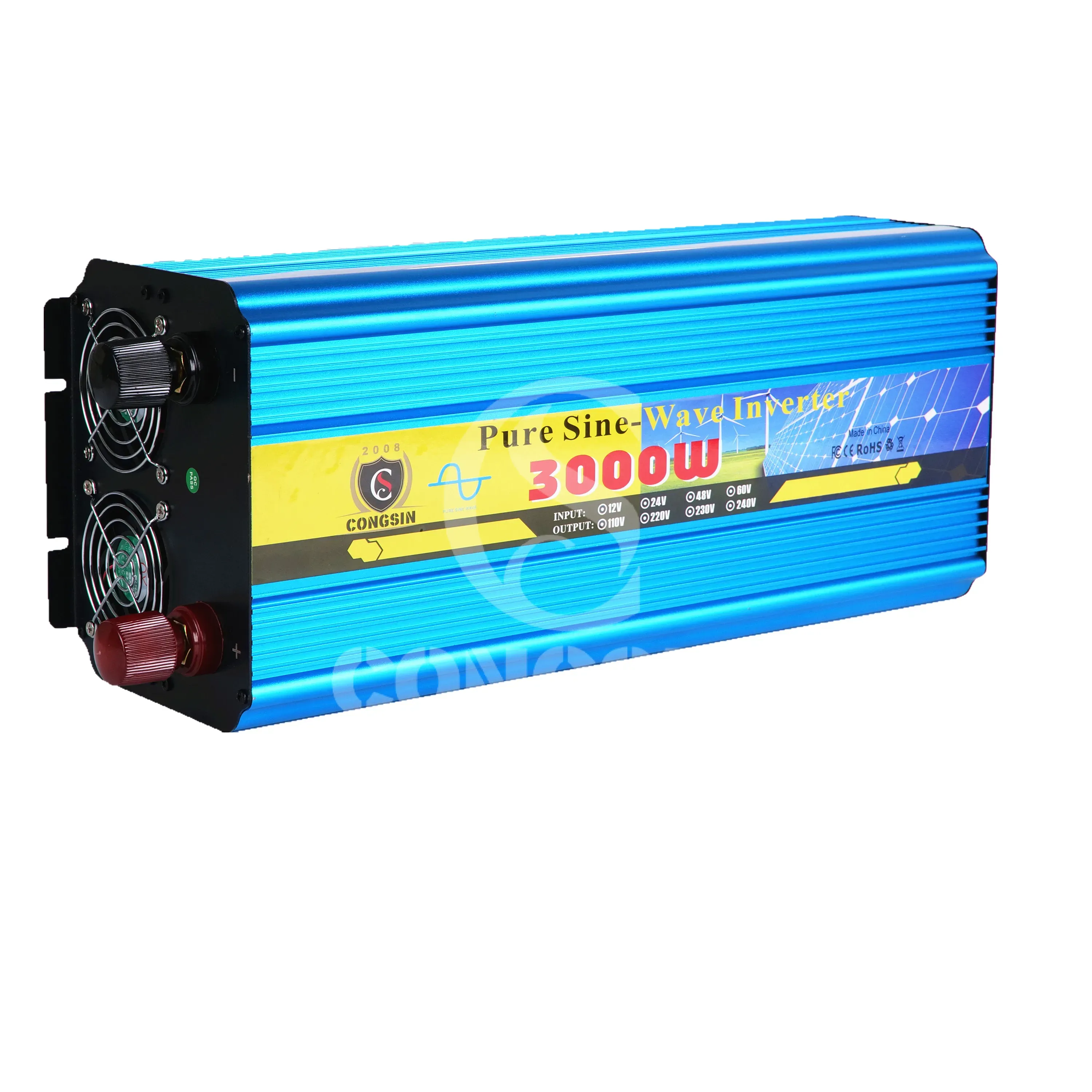
Congsin 3000W LCD Pure Sine Wave Inverter for Home Use Solar Backup Power Inverter Off Grid UPS
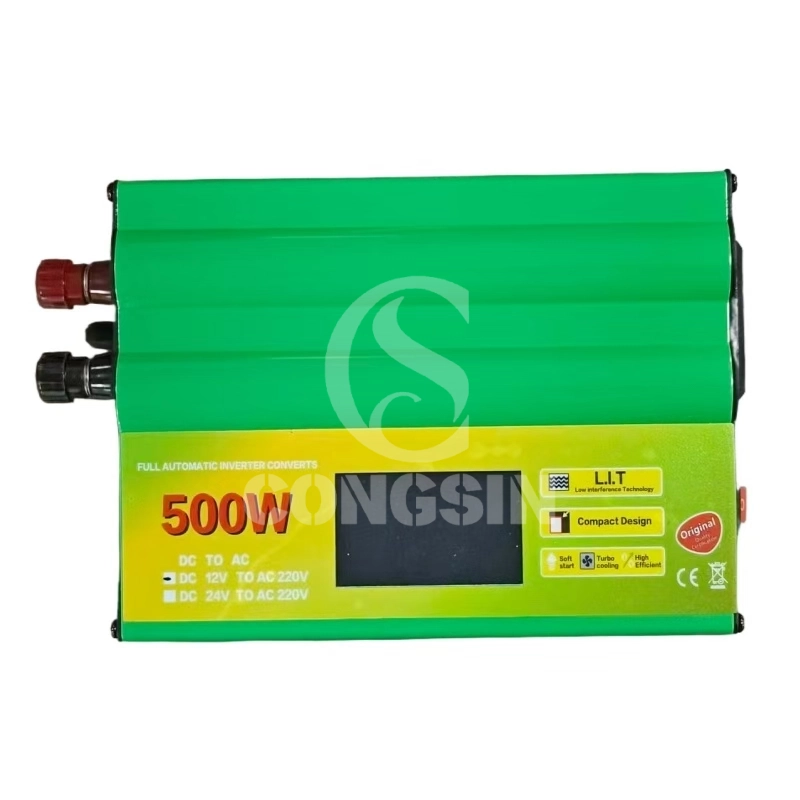
Congsin Modified Sine Wave Inverter 500W 1000W 1500W 12V LED Display Portable for RV Car Solar
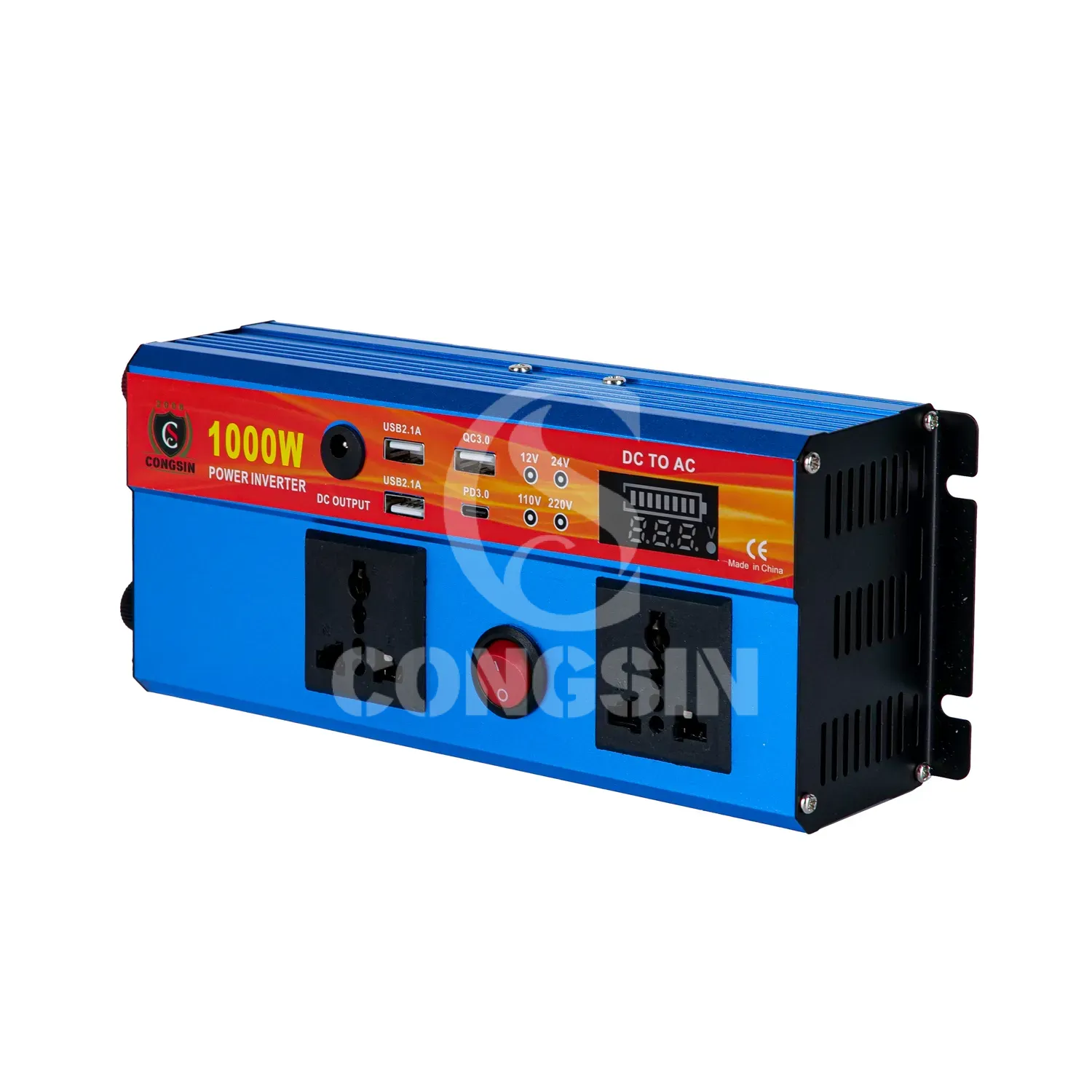
Congsin 1000W modified sine wave inverter with LED display and Type C port car RV power inverter
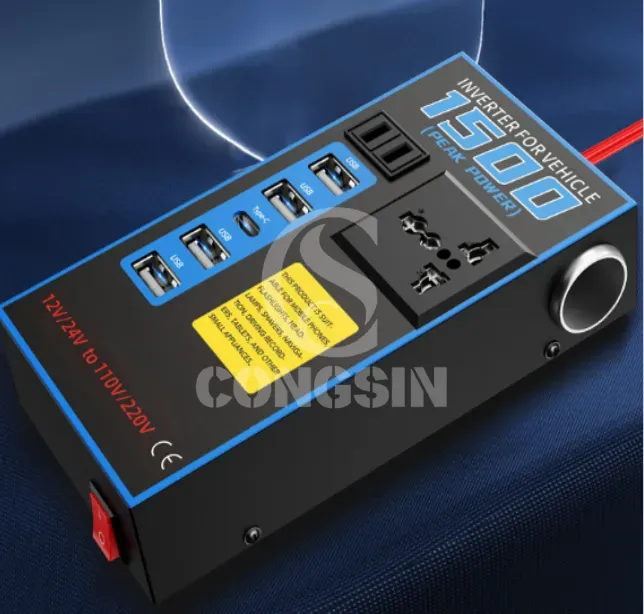
Congsin 1500W Inverter for Vehicle DC 12V/24V to AC 110V/220V with Universal socket Modified Sine Wave

CONGSIN is a trusted OEM factory for power inverters, solar charge controllers, and DC converters. Reliable solutions for global B2B buyers.
 High Quality
 7/24 Service
 Guaranteed Warranty
© 2025 Congsin. All Rights Reserved.